This project explores Ai-assisted character development for film and visual storytelling. Beginning with original concept art, I use Ai tools to explore cinematic interpretations, guiding the imagery in a cohesive visual direction.
My background is in concept design for film and television, where clarity of form, consistency, and narrative intent are essential. In integrating Ai tools into my process, I’m interested in how these systems can support ideation and production - while still maintaining authorship and design integrity.
What follows is a breakdown of my workflow, including both the strengths and limitations I’ve encountered when collaborating with Ai.

This character study is inspired by the traditional folk ballad The Bonny Swans, famously interpreted by the musical artist, Loreena McKennitt.
In the story, a young woman is drowned by her jealous sister, transforms into a swan, and later into a harp that sings of her betrayal before the royal court.
My interpretation places the story in pre-Christian Iceland (700-800 AD), drawing on research into early Scandinavian clothing and adornment traditions.
Character Design: Lyra (The Youngest, the Hero)
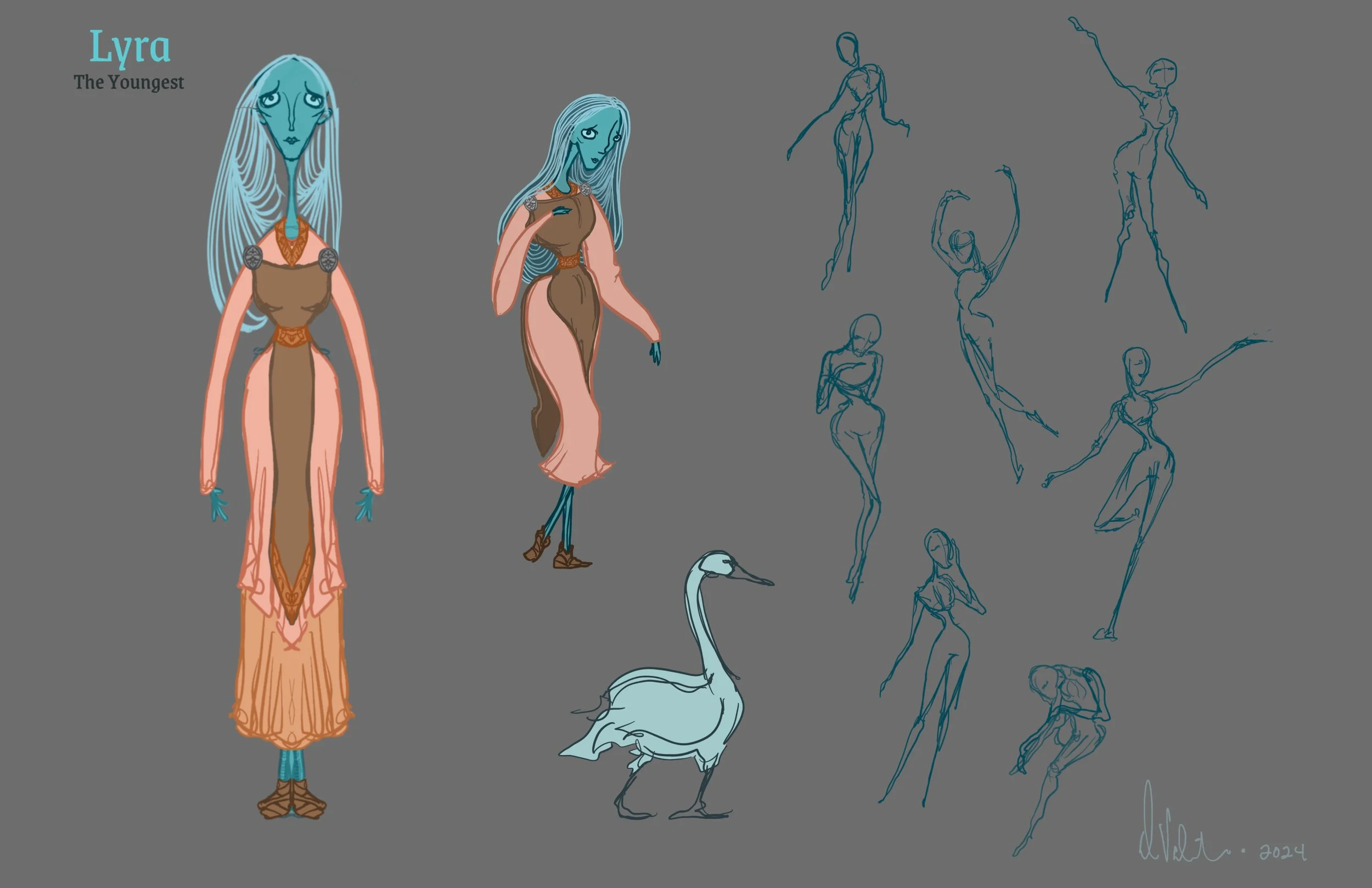
Lyra embodies innocence, grace, delicacy, truth and love.
Her emotional tone, symbolism, and silhouette were developed through research, visual exploration, moodboards, written ideas, and extensive sketch iteration.
I explored countless variations — searching for the balance between strength, fragility, mystery, and myth.
Once the core character design was established traditionally in 2D, I began integrating AI tools into the workflow as a collaborative extension of the visual development process.
Lyra exists at the intersection of traditional artistry and emerging technology — a character shaped through drawing, intuition, narrative design, and iterative experimentation.
AI became part of the process only after the soul of the character already existed.
All of this can be viewed here for Lyra:
AI Integration — First Pass
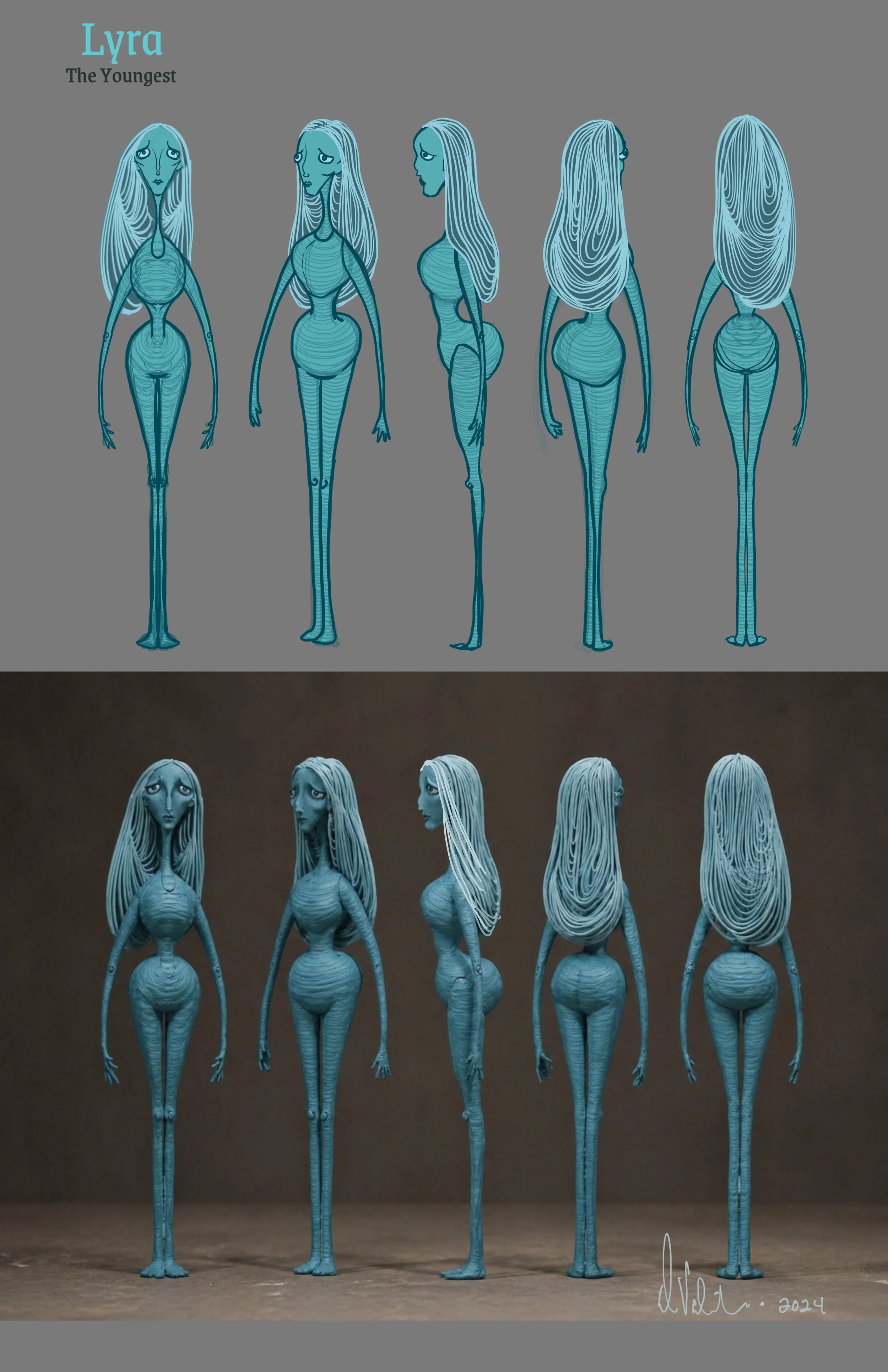
My first step in introducing AI into the process was training the model on my original turnaround drawings so it could begin to understand Lyra’s shape language, proportions, and overall emotional essence.
Using these designs as the foundation, I generated an initial clay-inspired character model that I could begin refining and developing further.
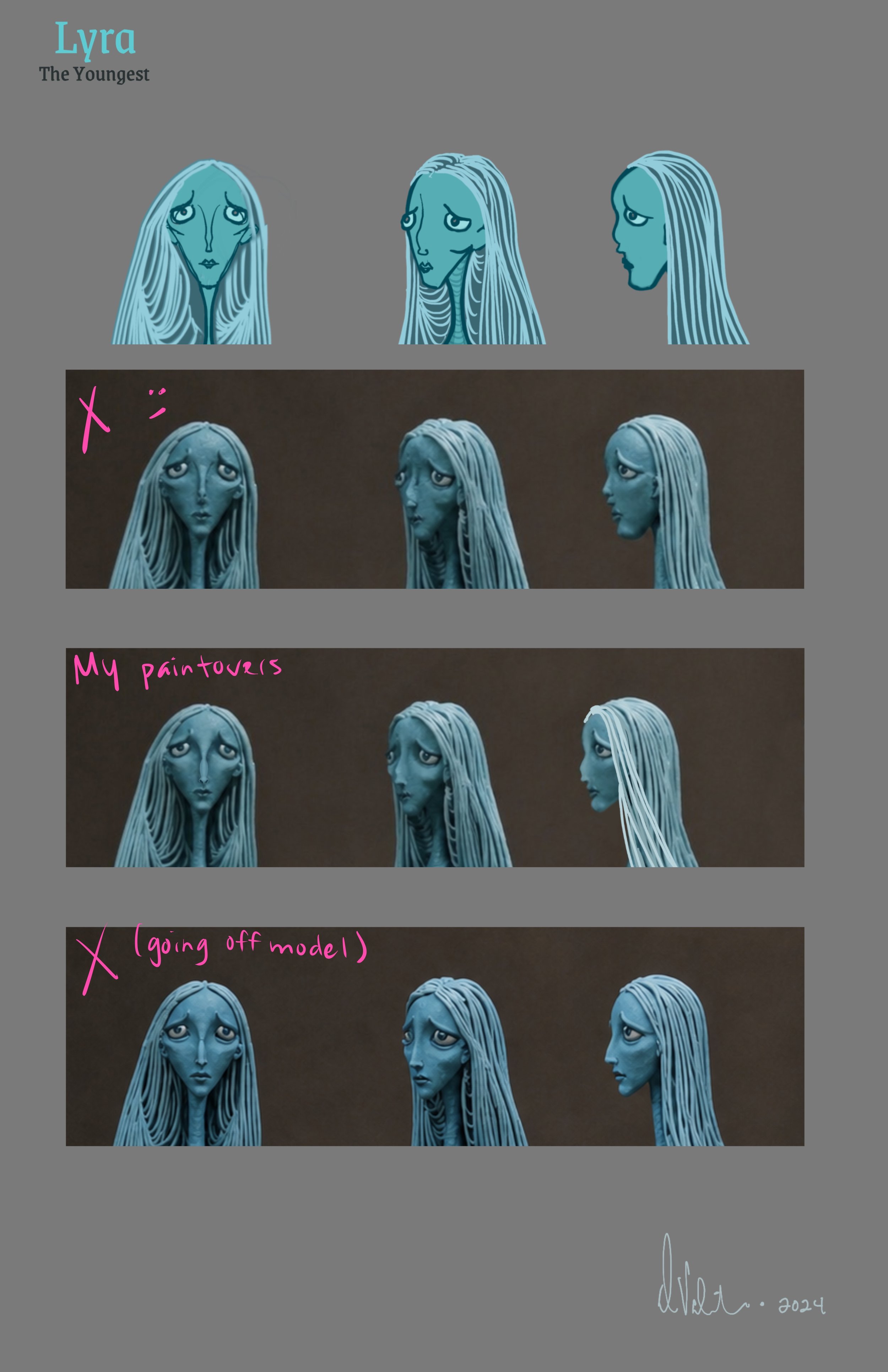
While the results were promising, certain subtleties of the design proved more difficult for the AI to interpret — particularly Lyra’s nose, which was intentionally designed to feel slightly irregular and imperfect. In this world, I wasn’t interested in creating conventionally “perfect” princess characters; I wanted her features to retain a sense of humanity, individuality, and quiet asymmetry.
I manually corrected and guided these details through multiple iterations, though with limited success at this early stage. Rather than forcing the process, I chose to continue exploring and return to those refinements later as the character evolved further.
Costume & Texture Development
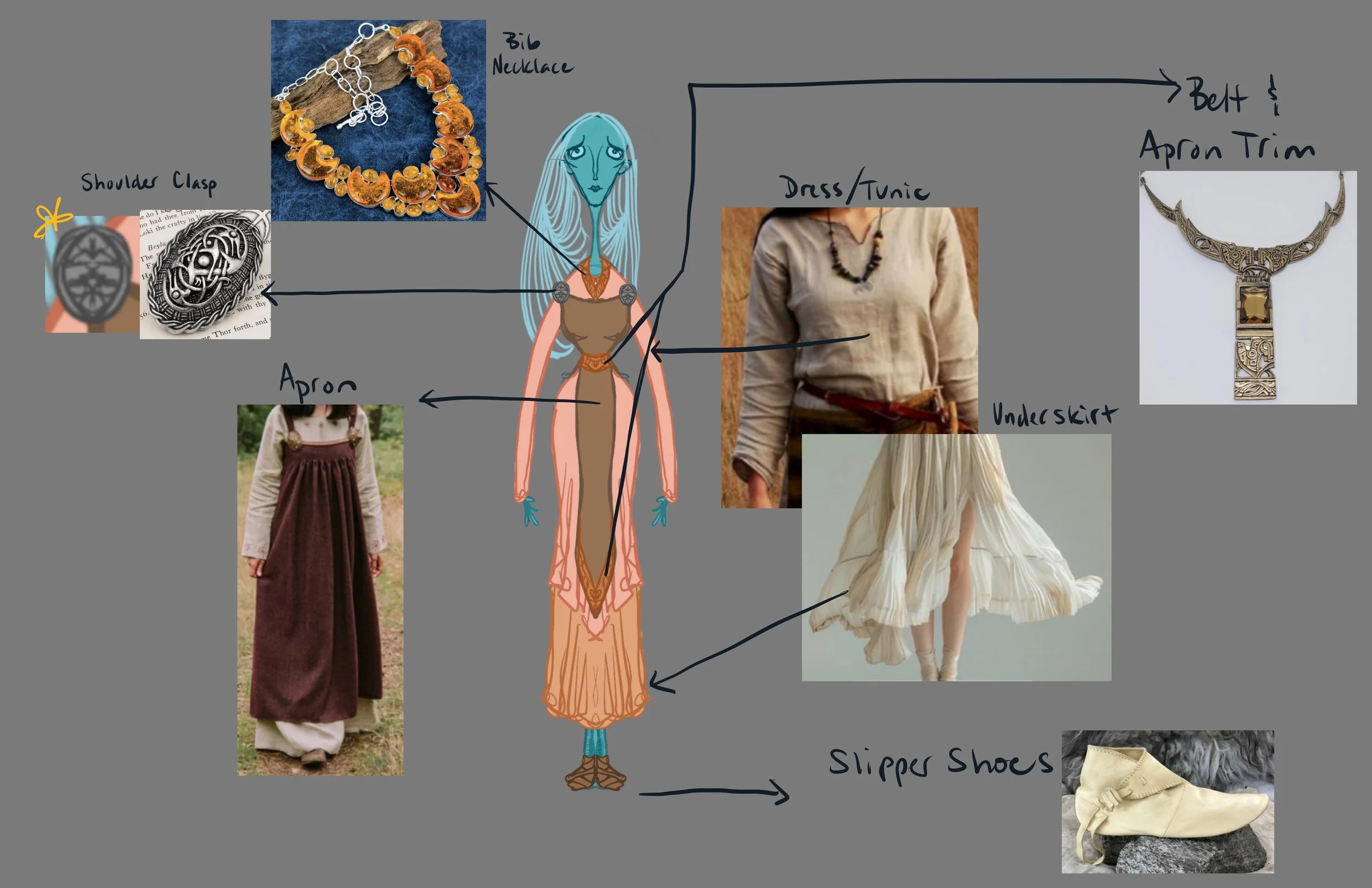
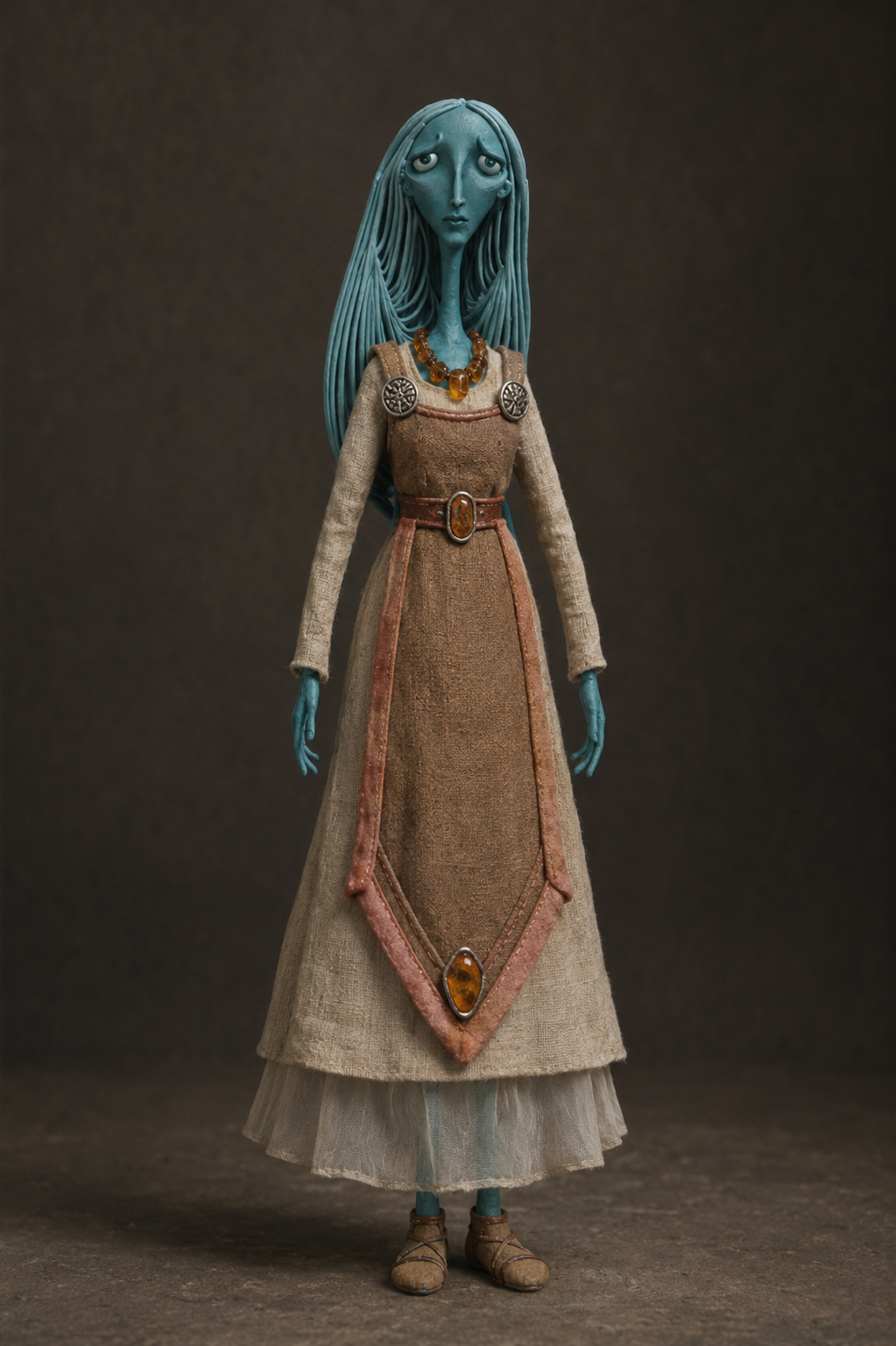
With the foundational character model established, the next step was developing Lyra’s costume language, materials, and surface textures.
Using my original costume sketch alongside carefully selected textile and accessory references, I guided the AI toward a tactile, handcrafted stop-motion aesthetic that felt appropriate to her world and personality.
This first pass successfully captured much of what I was searching for — Lyra’s delicacy, melancholy, and quiet sensitivity translated beautifully into the clay-inspired form. The layered fabrics, aged materials, and subtle ornamentation began grounding her within a believable physical world.
At the same time, many of the finer details still required refinement and artistic correction. As with every stage of the process, the AI-generated output became a foundation rather than a final result — one that I continued shaping manually through editing, repainting, and iterative design adjustments.
Manual Refinement & Iteration
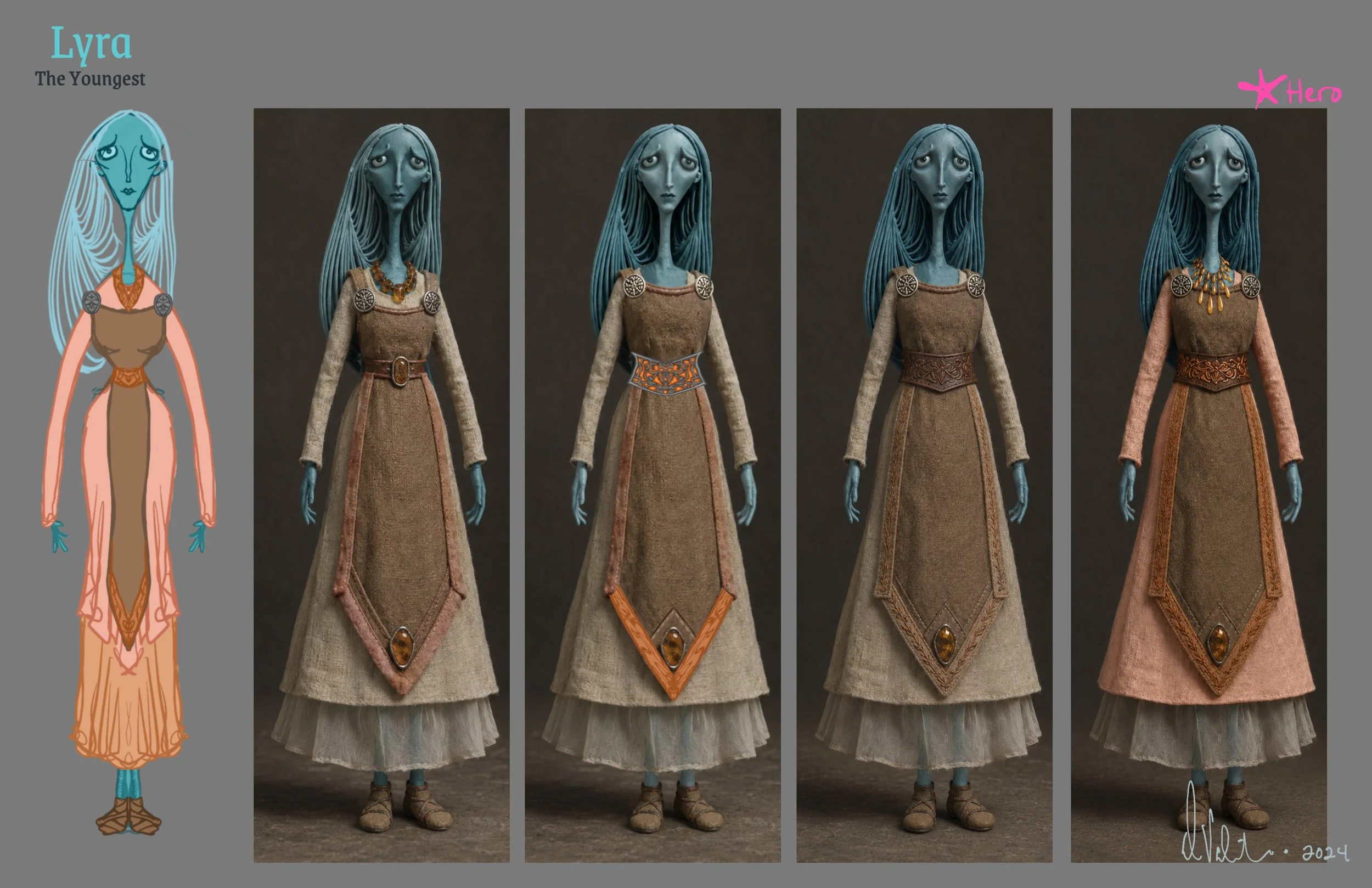
With the foundational costume and textures established, I began a series of manual refinements and design iterations to bring the character closer to my original concept artwork.
Across each version, I adjusted proportions, costume details, ornamentation, colour relationships, and material balance — gradually refining the design language until the character felt cohesive both aesthetically and emotionally.
This stage became less about generation and more about selective art direction: identifying what was working, correcting what wasn’t, and preserving the qualities that made Lyra feel uniquely herself.
The final “hero” version represents the iteration I felt most successfully captured the spirit of the original drawing while fully embracing the tactile, handcrafted stop-motion aesthetic I was aiming for.
Final Hero Design
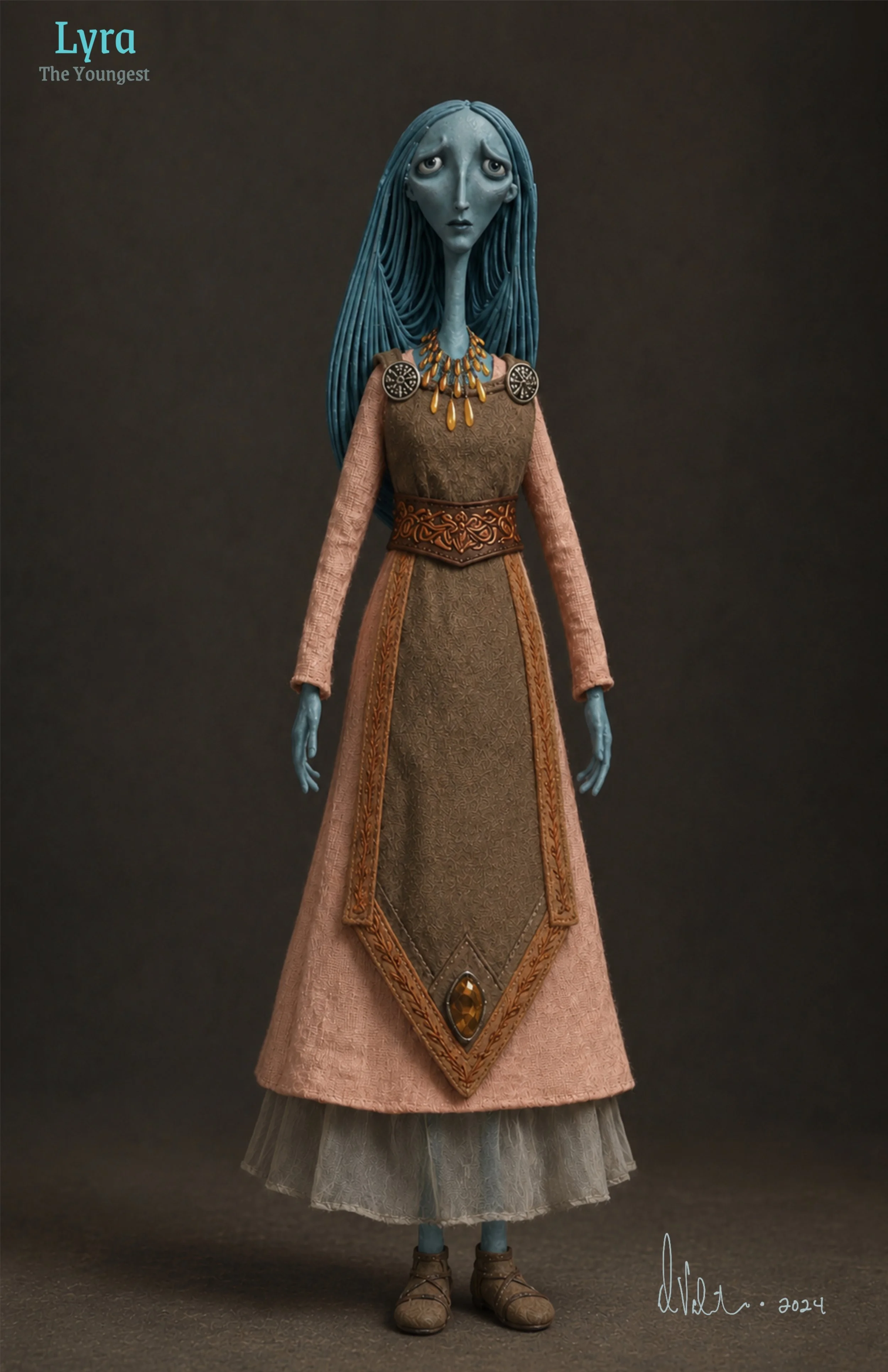
The final design for Lyra was the result of many small refinements, adjustments, and intuitive choices made throughout the process.
I wanted her to feel delicate, emotionally open, and quietly otherworldly — a character carrying both fragility and resilience within her design language. Her elongated proportions, muted palette, worn textiles, and handcrafted imperfections all helped support that emotional tone.
Small details became important storytelling tools. The final necklace design, for example, resembled falling teardrops or droplets of water — a subtle visual motif that reflected both Lyra’s sensitivity and the emotional undercurrents of her story.
At this stage, the character finally felt fully integrated: the original drawing, the tactile stop-motion aesthetic, and the emotional essence of the character all aligning into a cohesive final form.

Character design: Gudrun (the Eldest)
In this interpretation of The Bonny Swans myth, Gudrun represents the darker emotional force within the story - jealousy, ambition, and betrayal.
While her younger sister embodies innocence and transformation, Gudrun is imagined as a more severe and commanding presence. Her costume design reflects a harder silhouette and darker palette, suggesting both social authority and emotional distance. Gudrun is a figure of quiet intensity - poised, controlled and ultimately tragic in the role she plays within the myth.
Foundation & Process Development
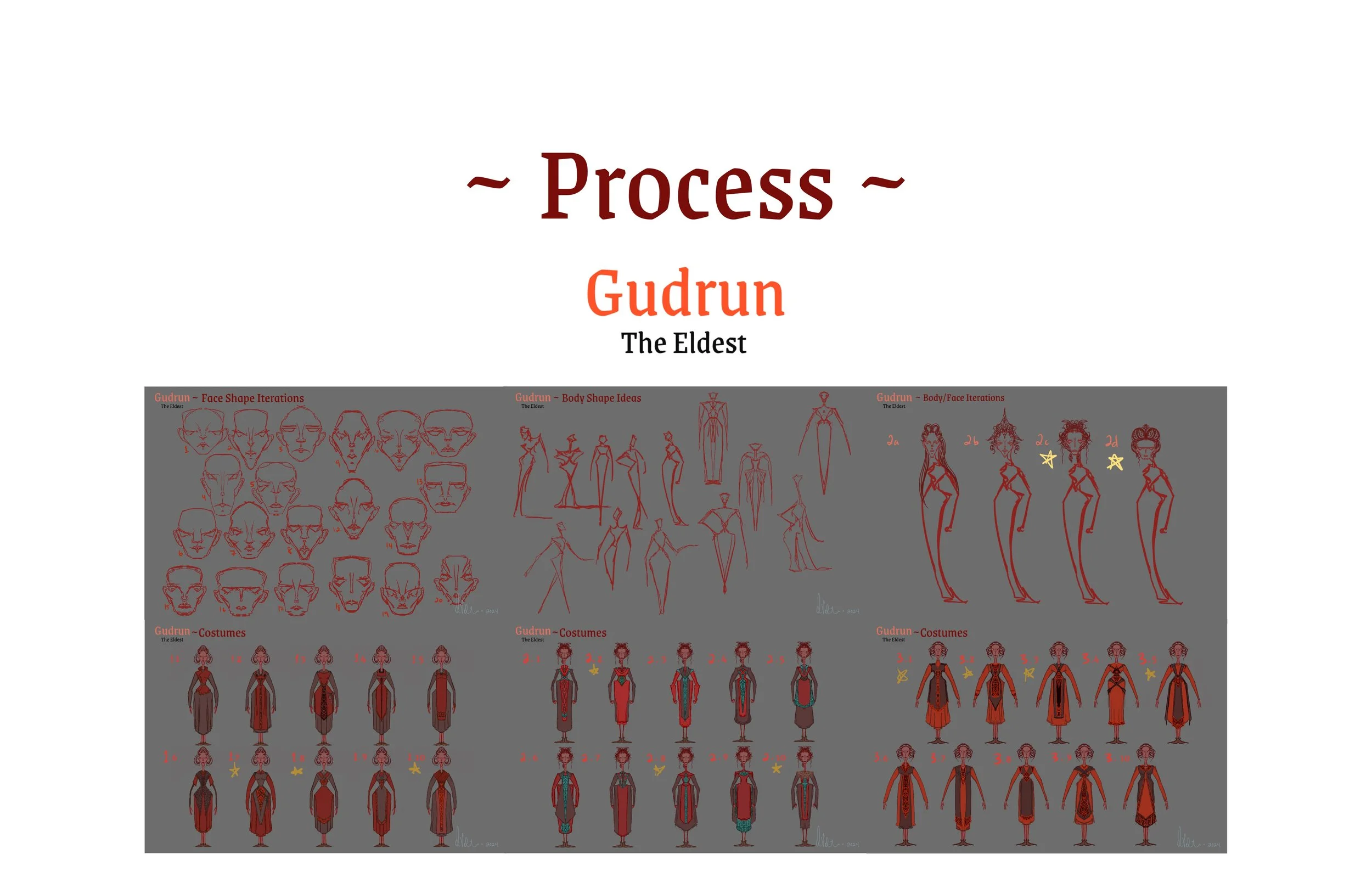
The foundation of this character was developed through traditional methods: research, iteration, and hand-drawn exploration.
This phase includes historical references, silhouette studies, facial exploration, and costume development. These steps establish the visual language and narrative identity of the character before introducing AI into the workflow.
AI is most effective in my process once the concept has reached a level of clarity and cohesion.
Character Definition (Pre-Ai)
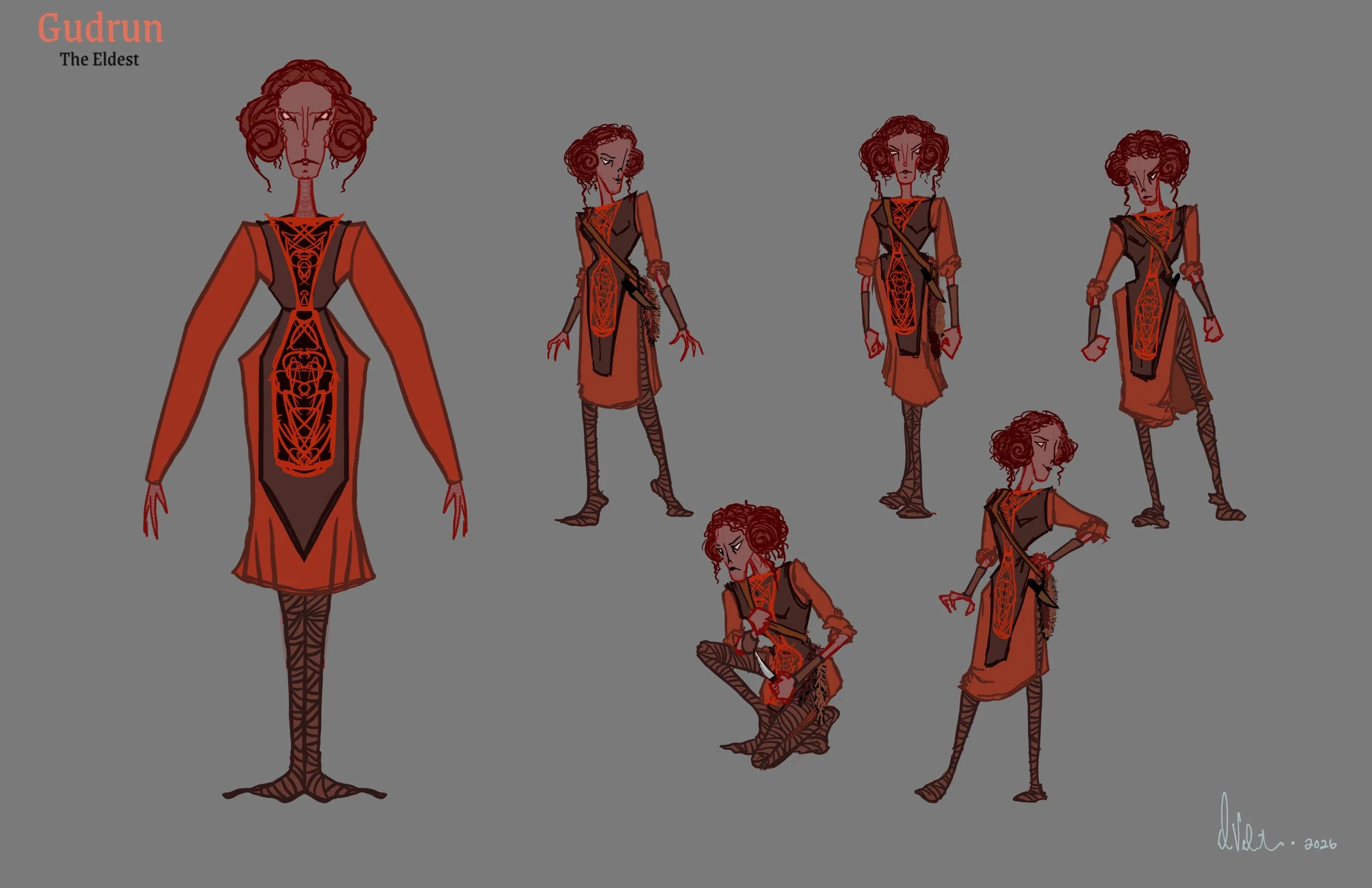
The finalized character design is established through hand-drawn exploration.
These drawings define proportion, silhouette, costume, and personality. At this stage, no AI tools are used. This ensures that the core design decisions remain intentional and authored.
I’ve found this step to be critical—AI performs best when guided by a clearly resolved concept rather than generating one from scratch.
Material Translation & First Ai Pass
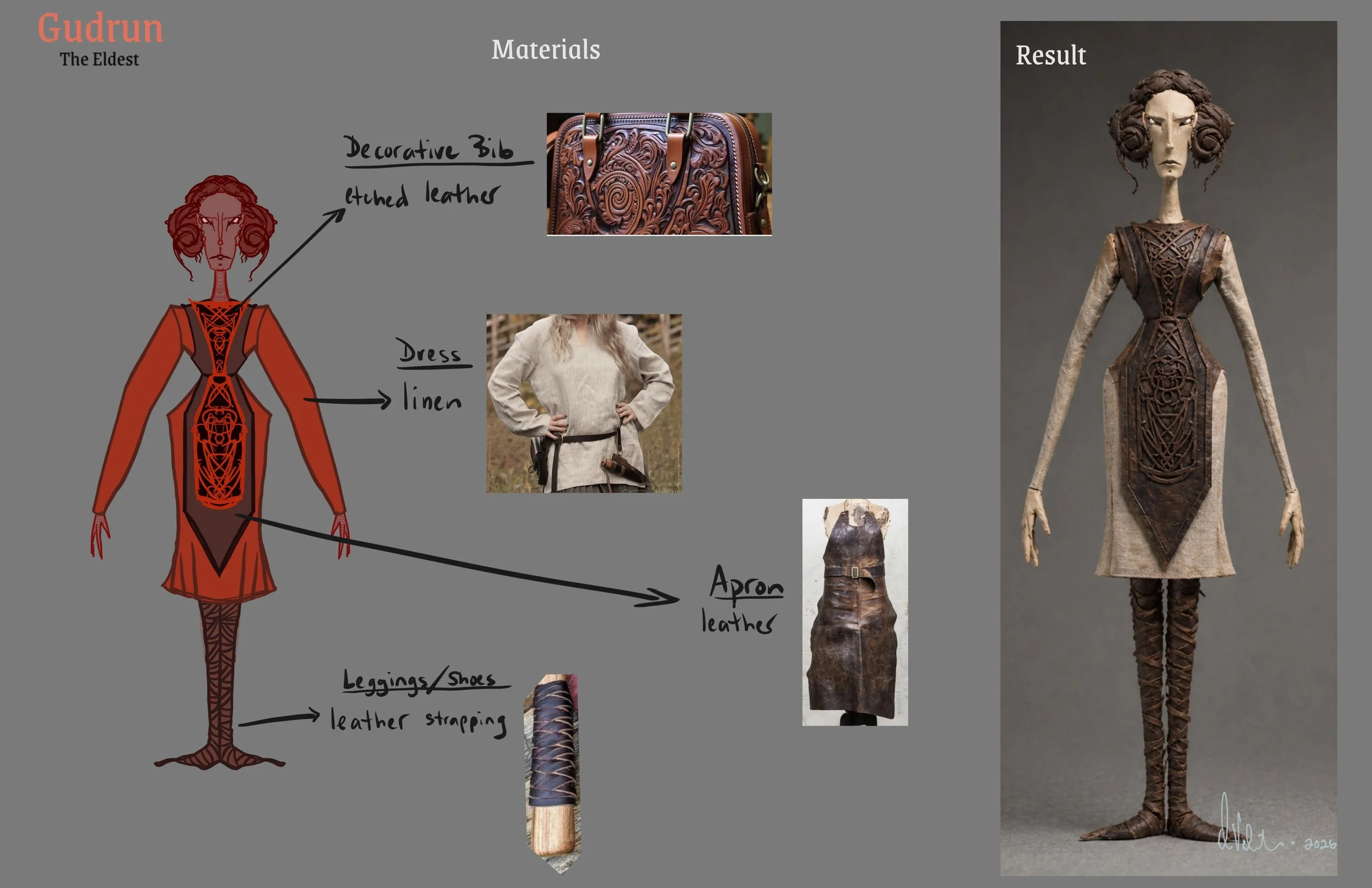
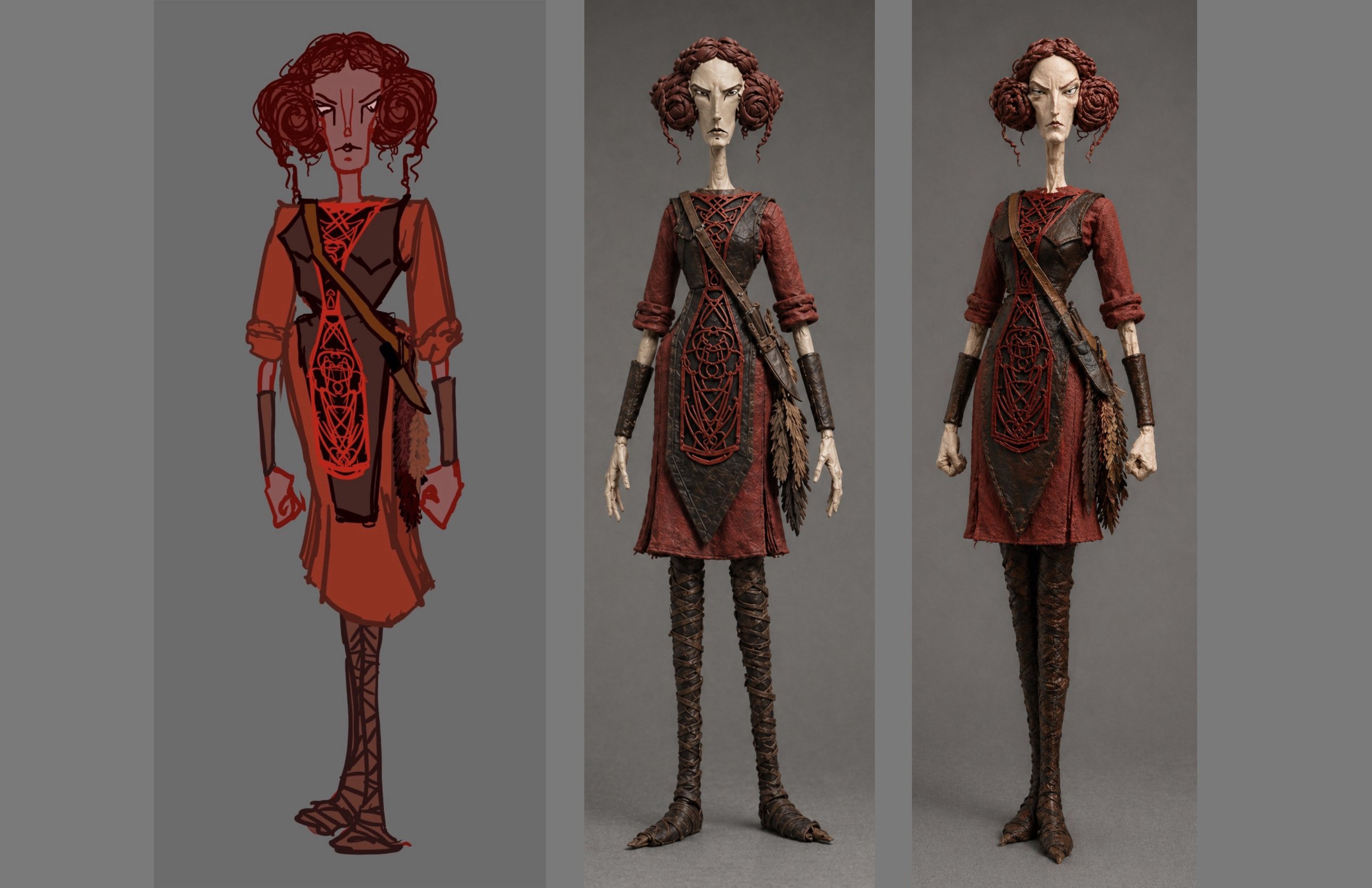
To translate the character into a stop-motion puppet aesthetic, I broke down the design into clear material components (linen, leather, stitched detailing, etc.) and used these as inputs for the AI model.
The resulting image successfully captured much of the structure and material quality of the design. However, colour accuracy was inconsistent and required manual correction.
This highlights a key strength of AI in this workflow: strong interpretation of form and texture, with less reliability in precise colour control.
Manual Colour Correction & Layered Editing
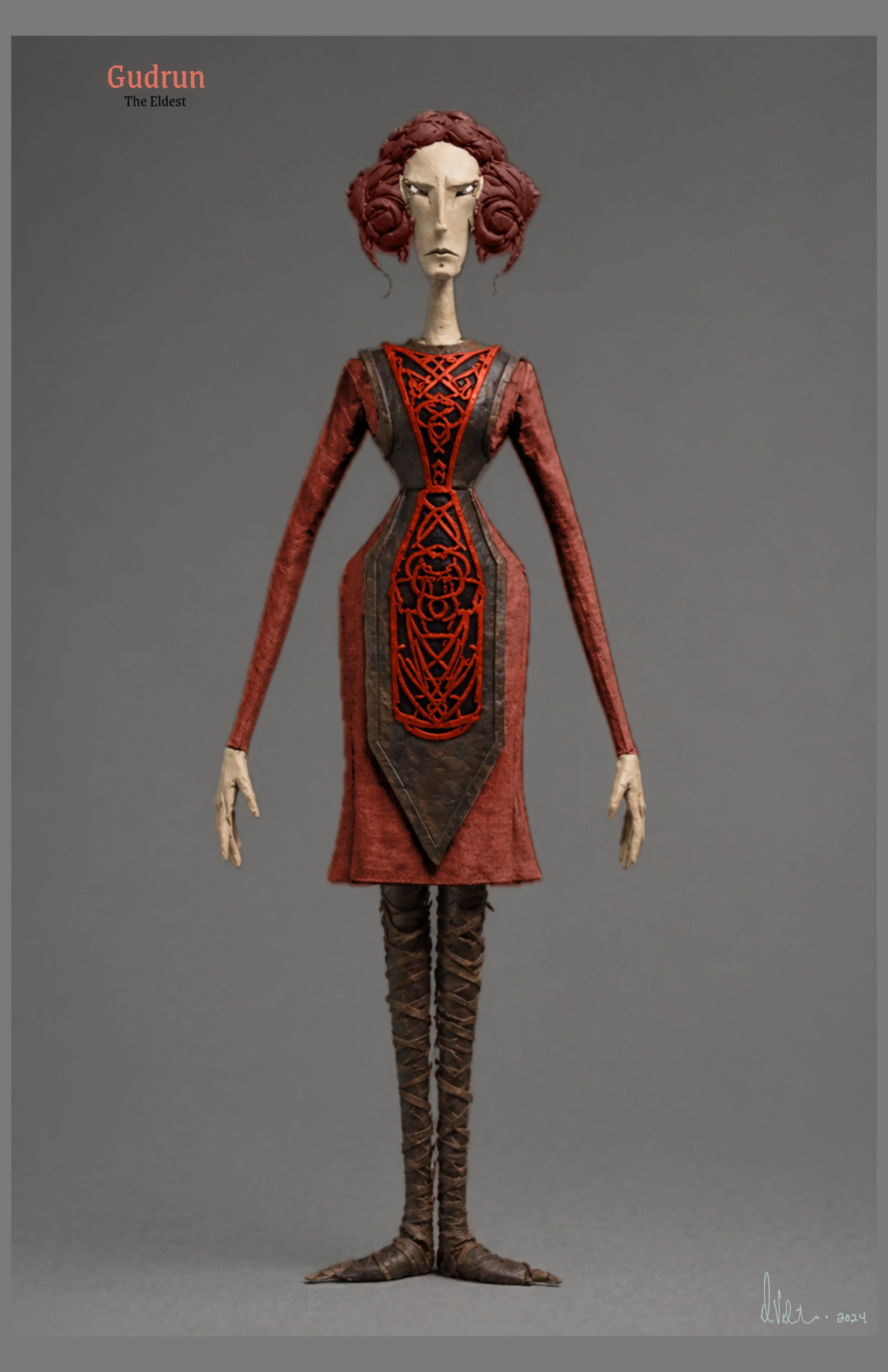
To bring the image in line with the intended design, I manually adjusted colour and surface detail.
My workflow involves isolating elements into separate layers and refining them individually. This allows for precise control and flexibility—particularly when exploring variations or correcting inconsistencies.
This step reinforces an important aspect of my process: AI outputs are not final—they are part of an iterative pipeline that includes hands-on refinement.
Turnarounds & Consistency Challenges
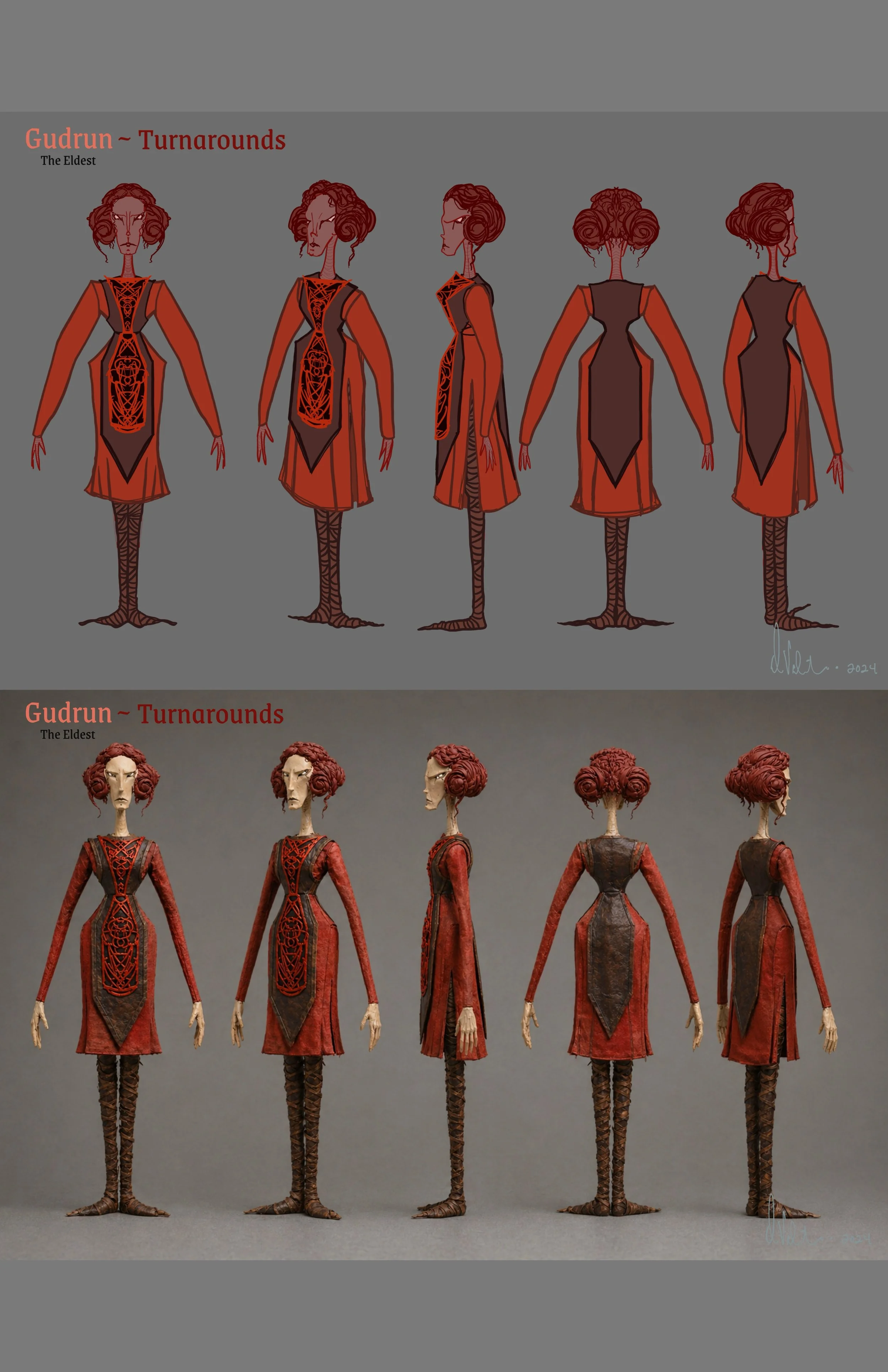
Using my drawn turnarounds and the refined hero image, I generated additional views of the character.
While the AI was able to approximate the structure, consistency across views—particularly in colour and detailing—was not fully maintained.
Global adjustments were applied to bring the set closer together, though more granular refinements would be required for production-level accuracy.
Maintaining consistency across iterations remains one of the key challenges in this workflow.
Pose Exploration & Model Drift
In this stage, I explored posing the character while introducing new design elements.
While the AI was able to interpret aspects of the pose and styling, the character began to drift from the original design—both in structure and detail.
This reflects a core limitation: without strict constraints, the model prioritizes reinterpretation over fidelity.
Future iterations will focus on reinforcing design consistency while continuing to explore expressive posing.
Ongoing Exploration
This workflow represents an ongoing dialogue between traditional design methods and emerging AI tools.
AI offers significant advantages in visualizing form, texture, and variation—but requires careful direction and refinement to maintain design integrity.
I’m particularly interested in expanding this process toward fully realized, riggable 3D characters and exploring how AI might support that transition.
This is an evolving space, and my approach continues to develop alongside the tools themselves.